
Nuclear safety in Ukraine remains under pressure as military actions continue. The Authority for Nuclear Safety and Radiation Protection (ANVS) uses updates by the International Atomic Energy Agency (IAEA) to stay aware of the situation at the occupied Zaporizhzhia nuclear power plant and other nuclear facilities around the country.
ANVS monitors nuclear safety in Ukraine
Russia and Ukraine have been at war since 24 February 2022. The IAEA is keeping a close eye on nuclear safety in these countries, as they are both home to various nuclear power plants. We are doing so as well, with special attention to the impact on the Netherlands. We receive information through the IAEA, foreign regulators and the Dutch National Institute for Public Health and the Environment (RIVM). Our Crisis Expert Team for radiation and nuclear (CETsn) is also standing by if needed.
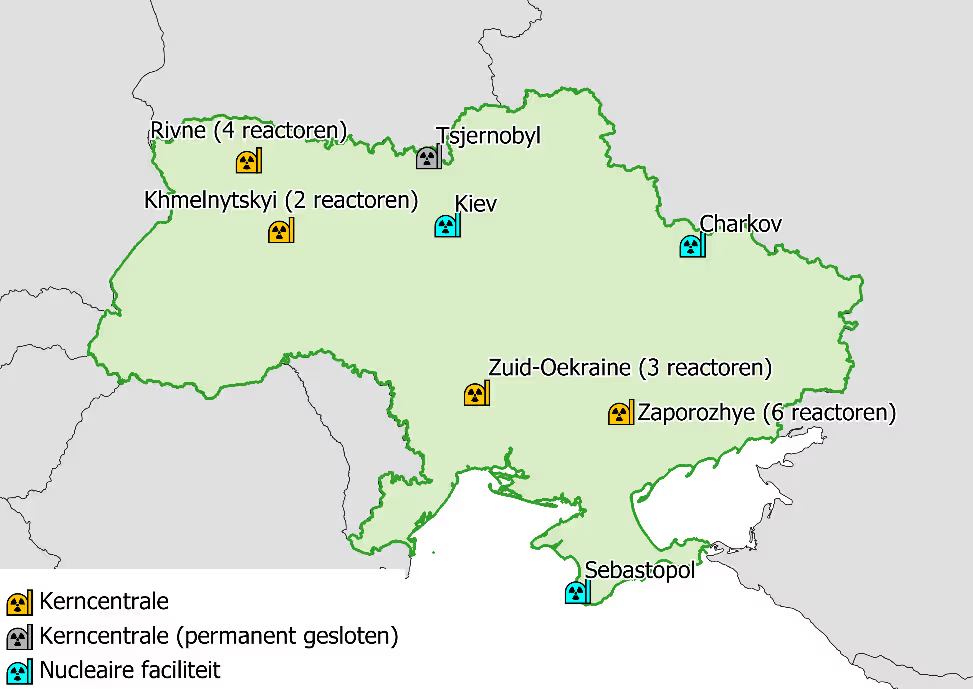
Nuclear facilities in Ukraine
Military action near Zaporizhzhia nuclear power plant
On 30 May, the IAEA learned that a turbine hall at the Zaporizhzhia nuclear power plant had been hit by a drone. Inspectors from the IAEA were granted access to the building. They were able to determine that there were no increased radiation levels.
The damaged building is located right next to the Unit 6 reactor hall. The turbine hall itself does not contain any nuclear equipment. The turbines have not been in use since 2022.
Damaged power lines at Zaporizhzhia
Besides the damage to the turbine hall, the plant has also been having problems with its off-site power connections. The Zaporizhzhia nuclear power plant was shut down as a precaution, soon after the war began. This reduces the energy required to cool the fissile material in the reactors. Two 750 and 330 kV power lines connecting to Ukraine’s power grid are used to supply the energy.
The main 750 kV line has been non-operational since 24 March 2026 due to military action. Since then, the plant has been without power three times due to the backup 330 kV power line also going down for brief periods. The nuclear power plant has diesel generators with enough fuel to provide up to 20 days of emergency power in such cases. The plant has already had to make use of this option 15 times since 2022. The IAEA has been negotiating a temporary ceasefire between Ukraine and Russia to allow for repair of the power lines.
Hit to monitoring equipment used for Zaporizhzhia crisis management
A team of IAEA observers has been permanently stationed at the Zaporizhzhia nuclear power plant. On 3 May, these observers were informed that a drone had damaged one of the plant’s monitoring stations. This station is located at a distance of 4 kilometers from the nuclear power plant. It is used to monitor radiation levels and weather conditions during emergencies. An inspection revealed that the weather monitoring equipment had sustained damage.
Forest fire in Chernobyl
The nuclear power plant at Chernobyl has been shut down since 2000. On 11 May, a forest fire erupted in the exclusion zone surrounding the former plant. This fire is now under control. Radiation levels stayed within normal limits during the fire. The exclusion zone was established following the nuclear disaster at Chernobyl’s reactor 4 in 1986, 40 years ago.
IAEA inspects power supply for all Ukrainian nuclear power plants
Besides the Zaporizhzhia plant, Ukraine also has three other nuclear power plants in Rivne, Mykolaiv and Khmelnytsky. These plants are in operation to supply Ukraine with power. Here, too, safety is under threat due to the war.
Instabilities in the power grid have already necessitated reduced operations or a full shut down more than once. A team from the IAEA has therefore carried out inspections of 14 power grid substations. They investigated the damage and progress of repairs. This is the 7th substation inspection since September 2024.
Drone flights near Ukrainian nuclear power plants
The IAEA receives regular reports of drone sightings and other military action near the three nuclear power plants and the site at Chernobyl. According to the agency, nuclear safety is not directly affected by passing drones. However, as the IAEA's Director General Rafael Mariano Grossi says, “Any military action in the vicinity of a nuclear facility significantly increases the risk of nuclear disaster.”
Grossi calls for the greatest restraint on both sides. He also emphasizes the importance of the IAEA’s Seven Indispensible Pillars, seven principles intended to ensure nuclear safety and security during the conflict.